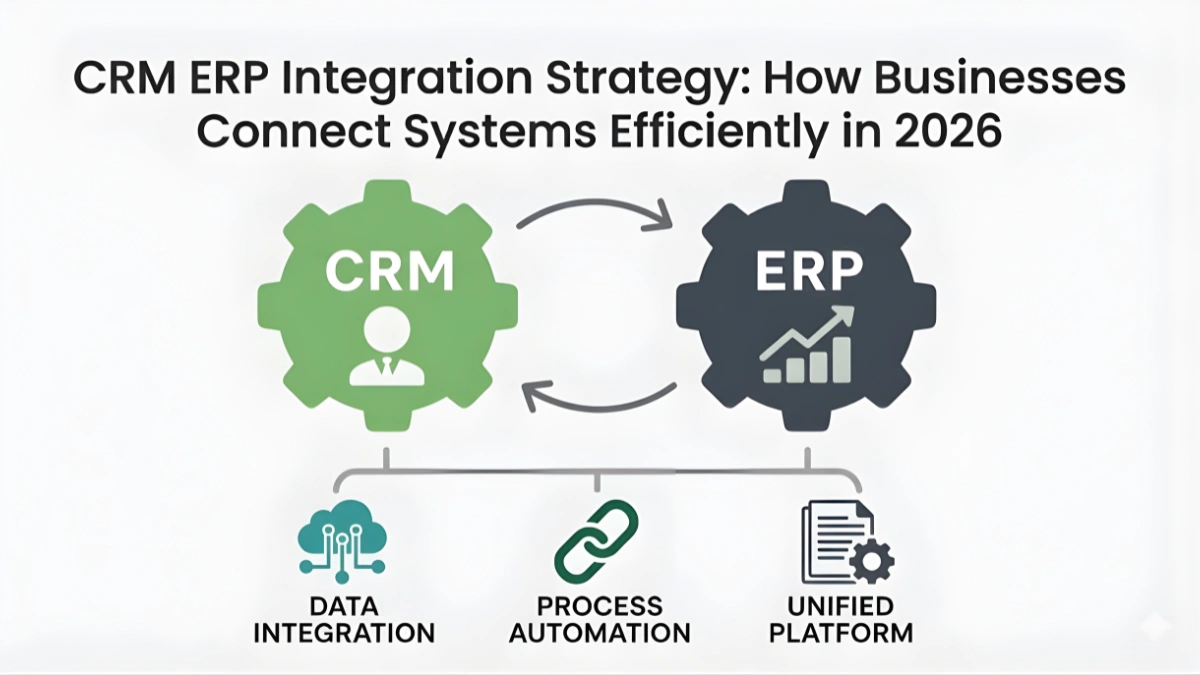
Integrating CRM and ERP systems has become one of the most important digital priorities for businesses because customer data, finance, inventory, operations, and sales decisions now need to move through one connected ecosystem. When CRM and ERP remain separate, businesses often face duplicate records, delayed decisions, inconsistent reporting, and slower customer response times.
A strong integration strategy allows customer-facing teams and operational teams to work from the same real-time information. The framework you shared clearly shows that CRM and ERP integration is now considered a core business efficiency project because it improves visibility across departments and reduces manual process dependency
Why CRM and ERP Integration Matters
CRM handles customer relationships while ERP manages internal operations.
When both systems work together, businesses gain:
- Unified customer records
- Faster order visibility
- Better financial accuracy
- Improved service coordination
This creates stronger decision-making across departments.
How Integrated Systems Improve Daily Operations
Without integration, sales teams often work separately from finance and inventory teams.
This creates delays because customer information must be checked manually.
Integrated systems solve this by allowing:
- Real-time order visibility
- Inventory access during sales conversations
- Invoice visibility across departments
This improves business speed.
Main Business Benefits of CRM + ERP Integration
Companies that connect both systems usually improve:
- Forecasting accuracy
- Order processing speed
- Internal reporting quality
- Customer service consistency
This creates measurable operational value.
Top Integration Tools Businesses Commonly Use
| Integration Tool | Main Strength | Pricing | Best For |
|---|---|---|---|
| MuleSoft Anypoint | API integration and data mapping | Custom pricing | Large enterprises |
| Zapier | Fast workflow automation | Free / Paid tiers | Small and medium businesses |
| Microsoft Power Automate | Enterprise automation | $15+/user | Microsoft ecosystem users |
| Make | Flexible visual automation | Free / Paid tiers | SMB automation projects |
How API Integration Helps
API integration remains one of the strongest methods because it allows systems to exchange data directly.
This usually supports:
- Customer updates
- Order sync
- Invoice movement
- Inventory visibility
This improves real-time performance.
Why Middleware Is Popular
Middleware tools help businesses avoid complex custom development.
They simplify integration by creating workflow bridges between systems.
This works especially well when businesses need fast deployment.
Common Integration Challenges
Several problems appear when planning CRM and ERP integration.
The most common include:
- Data inconsistency
- Duplicate records
- Weak field mapping
- Process confusion
These issues usually appear when planning is weak.
Why Data Quality Matters First
Before integration begins, businesses should clean records carefully.
Poor data often causes:
- Wrong reporting
- Duplicate customer profiles
- Invoice mismatches
This weakens the value of integration.
Why Employee Adoption Is Important
Even strong integration fails if teams do not follow the new workflow.
Businesses usually improve adoption through:
- Process training
- Clear usage guidelines
- Department coordination
This helps systems deliver full value.
Long-Term Value of CRM + ERP Integration
When integration works properly, businesses gain stronger visibility across:
- Sales
- Finance
- Inventory
- Customer service
This improves long-term operational control.
FAQs
1. Can all CRM systems connect with ERP software?
Most modern platforms support integration.
2. Is custom integration always necessary?
No, middleware often works well.
3. Which tool is best for small businesses?
Zapier remains a common choice.
4. Does integration improve customer service?
Yes, faster data access improves response quality.
5. Is ERP + CRM integration expensive?
Cost depends on system complexity.
Conclusion: CRM and ERP integration has become essential because businesses now depend on connected data across customer management and internal operations. Companies that integrate both systems well usually improve efficiency, reporting quality, and long-term decision-making.
Disclaimer: This article is for informational purposes only. Integration tools, software capabilities, and pricing may change depending on vendor updates and business requirements. Companies should verify official product details before implementation.