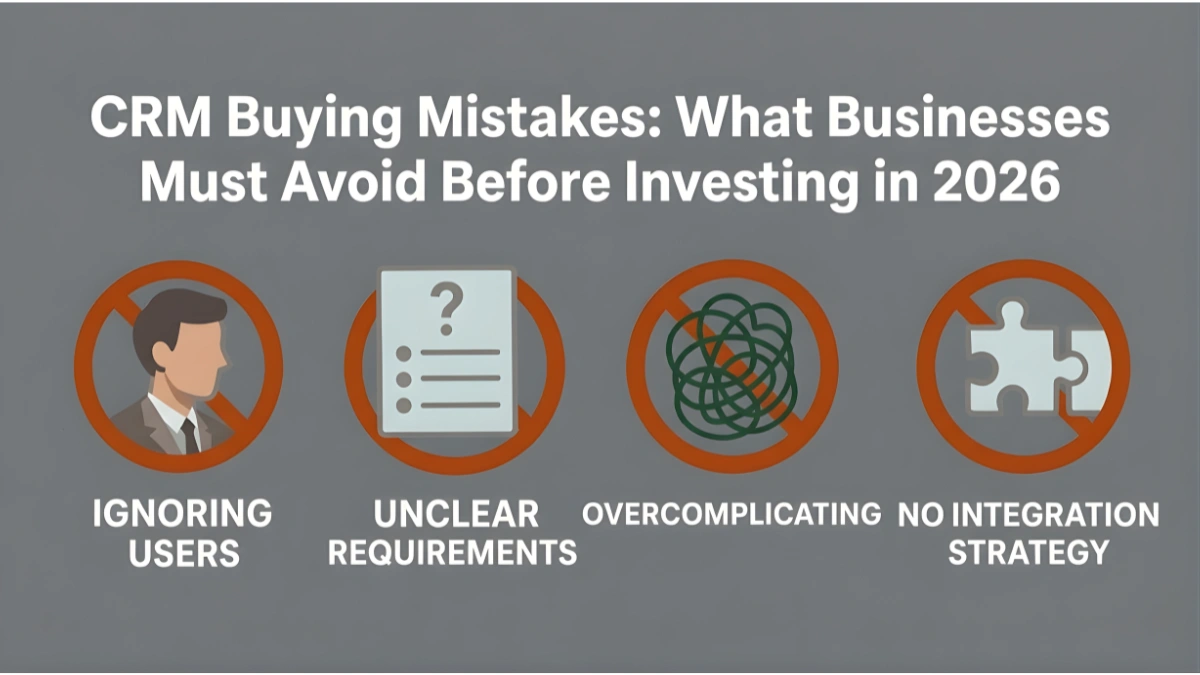
Choosing CRM software has become one of the most important software decisions for growing businesses because the wrong platform often creates long-term problems in sales execution, reporting quality, team adoption, and customer visibility. Many companies focus heavily on brand reputation or feature lists but overlook practical business fit, which later results in poor usage, expensive upgrades, or even full software replacement.
In high-value SaaS and enterprise software markets, CRM buying decisions attract strong advertiser attention because businesses actively compare pricing, integrations, AI features, and long-term ROI before making software commitments. A CRM that fits actual business workflows usually improves customer management, automation quality, and reporting confidence, while a poor selection often increases operational friction.
Lack of Clear Business Objectives Before Buying
One of the most common mistakes is selecting CRM software before defining what the business actually wants to improve. Some companies buy CRM because competitors use it, while others focus only on software popularity.
A better approach is to define measurable priorities first, such as:
- Lead conversion improvement
- Faster follow-up workflows
- Better reporting visibility
- Stronger customer segmentation
Without these goals, feature comparison becomes misleading.
Ignoring Team Input During CRM Selection
CRM software affects multiple departments, but many businesses still make the decision using only leadership or IT input.
When sales, marketing, support, and operations teams are excluded, businesses often select systems that feel difficult in daily use.
User involvement helps identify:
- Workflow pain points
- Reporting needs
- Interface preferences
This improves long-term adoption significantly.
Choosing Software That Is Too Complex Too Early
A major buying mistake is selecting enterprise-level software before the business truly needs that level of complexity.
Many companies purchase advanced CRM platforms with heavy customization but later struggle because daily usage becomes difficult.
| CRM Choice Type | Risk | Business Impact |
|---|---|---|
| Overly complex CRM | Low adoption | Slow daily workflows |
| Underpowered CRM | Fast limits | Early migration need |
| Balanced CRM | Better usability | Stronger ROI |
The best CRM often matches current workflow while allowing future growth.
Ignoring Integration Requirements
CRM rarely works alone because businesses already use multiple systems for marketing, finance, communication, and operations.
Ignoring integration planning often creates serious workflow problems later.
Important connections usually include:
- Email systems
- ERP software
- Marketing tools
- Accounting platforms
Without these links, customer data becomes fragmented.
Underestimating Data Migration Difficulty
Many businesses assume old customer data will transfer easily, but migration often creates delays when records are inconsistent.
Common migration problems include:
- Duplicate contacts
- Missing fields
- Poor formatting
Data quality strongly affects CRM success after launch.
Not Evaluating Scalability Carefully
Some businesses choose low-cost CRM software without considering future growth.
A platform that works for 5 users may become restrictive for 50 users.
Scalability should always include:
- User expansion
- Workflow complexity
- Reporting depth
This avoids expensive future switching.
Weak Training and Change Management
Even excellent CRM software fails when users do not understand how to apply it consistently.
Businesses that skip proper onboarding often see:
- Low usage
- Inconsistent records
- Poor reporting quality
Training is often as important as software choice.
Ignoring Full Cost Beyond Subscription Price
Many CRM buyers focus only on monthly pricing but ignore long-term cost drivers.
Full CRM cost usually includes:
- Setup
- Integrations
- Support
- Advanced features
This often changes ROI calculations significantly.
Vendor Evaluation Must Go Beyond Features
A CRM vendor should also be evaluated for:
- Product roadmap
- Support quality
- Community strength
This affects long-term software reliability.
FAQs
1. What is the biggest CRM buying mistake?
Choosing without clear business goals.
2. Should all teams join CRM evaluation?
Yes, cross-functional input improves fit.
3. Is cheaper CRM always better early?
Not if it limits growth quickly.
4. Why do many CRM projects fail?
Poor adoption and weak planning.
5. Does integration matter before buying?
Yes, it should be checked early.
Conclusion: CRM buying mistakes usually happen when businesses focus more on software reputation than actual operational fit. Companies that define goals clearly, involve users, and evaluate long-term cost usually make stronger CRM decisions and avoid expensive corrections later.
Disclaimer: This article is for informational purposes only. CRM pricing, software capabilities, and vendor offerings may change depending on provider updates and subscription plans. Businesses should verify official product details before purchase.